Gravesend · Avenue P · Brooklyn 11223
Which lash style suits your eye shape
Free mapping every visit · Any style at any density
The short answer
Style is where length goes. Density is a separate decision.
A lash style is a map: which lengths go where along the lash line, and at what curl. Cat eye puts the longest lashes at the outer corner, doll eye puts them in the centre, kitten sits between the two, and wispy alternates heights for texture. Any of them can be built at any density, from classic 1D to mega volume 6D+. At DEEPINLASH, 1019 Avenue P in Brooklyn 11223, mapping takes about ten minutes, it is free with every set, and you approve the shape before a single extension is applied.
The four maps
What each one actually does.
Curl matters as much as length placement. A C curl lifts, a D curl lifts harder, and a flatter B or L curl is what a hooded lid needs so the lashes clear the fold instead of brushing it.
Squirrel, angel, manga, anime, wet look — most of the names you have seen are variations on these four, or a wispy map with a particular spike pattern. Show us the photo rather than the word. We can read a map out of an image in a few seconds, and the name attached to it on social media is frequently wrong.
By eye shape
Start here, then we adjust in the chair.
Find the row that sounds like you. None of this is a rule — it is where we start before we look at your actual lash line, which is always the thing that decides.
| Eye shape | How to tell | Usually | Careful with |
|---|---|---|---|
| Hooded | A fold of lid covers part or all of the crease when your eyes are open. Very common and frequently mapped wrong. | A flatter curl — B or L — in a cat eye or kitten map, with length kept moderate so lashes clear the hood rather than disappear under it. | Strong D curls and long doll-eye maps. They curl up into the fold and vanish, and you have paid for lashes nobody can see. |
| Round | The iris is visible all the way around; the eye is as tall as it is wide. | Cat eye. Length at the outer corner stretches the shape horizontally and takes the roundness down. | Doll eye, which makes a round eye rounder and can read startled in photographs. |
| Almond | Slightly longer than tall, with a visible taper at both corners. The shape most lash maps are designed around. | Anything. Kitten and wispy both sit beautifully, and cat eye works without needing correction. | Nothing in particular — which is why "what suits almond eyes" is mostly a question about density instead. |
| Downturned | The outer corner sits lower than the inner corner. | A lifted cat eye with a stronger curl at the outer third, so the line reads as rising rather than following the drop. | A long, flat cat eye. Length without curl at the outer corner exaggerates the downturn — the opposite of what you asked for. |
| Upturned | The outer corner sits higher than the inner corner already. | Doll eye or kitten, to balance the existing lift and add height through the centre. | Cat eye on top of a natural lift, which can tip from elegant into severe. |
| Close-set | Less than one eye-width between your eyes. | Length concentrated in the outer half, with the inner corner kept short. Pulls the visual centre apart. | Long lashes at the inner corner, which drag attention inward and close the gap further. |
| Wide-set | More than one eye-width between your eyes. | Doll eye, with real length carried into the inner third to bring the eyes visually together. | A hard cat eye, which stretches outward and widens the gap. |
| Monolid | No visible crease; the lid is smooth from lash line to brow. | A stronger curl than you would expect — D or a lifted C — so the lashes are visible from the front rather than pointing forward. | Flat curls and heavy length, which push straight out and read as weight rather than lift. |
| Mature or soft-lidded | Lid skin has relaxed over the lash line, often with a shorter natural lash underneath. | Shorter lengths at a lifted curl, and density from fine fans rather than from longer lashes. A kitten map, softly lifted. | Length. It is the most common mistake here: long extensions on a relaxed lid lean on the skin and drag the whole eye down. |
None of this survives contact with your actual lashes. Eye shape sets the starting map; the natural lash line decides what is possible on it. If your own lashes are short at the outer corner, a cat eye has nothing to build on there — so we map what you have, not what the chart says.
How mapping works
Ten minutes, drawn on the patch.
Mapping is not a consultation in the abstract. We draw the length zones on the under-eye patch, in pen, so you can look at the plan before anything is bonded to you.
- We look at eye shape, lid position and where the fold sits when your eyes are open — not closed.
- We look at your natural lash line: where it is dense, where it is thin, and how long your own lashes are. This is what caps the length.
- Curl is chosen from the lid, not from the photo. A hood needs a flatter curl; a monolid needs a stronger one.
- Zones go on the patch — typically four to six along each eye — and you see the shape.
- You approve it. Changing your mind here costs nothing; changing it after is an hour of work to undo.
Free with every set, every visit — not just the first one. Lash lines change, and a map that worked in March is not automatically the right one in September.
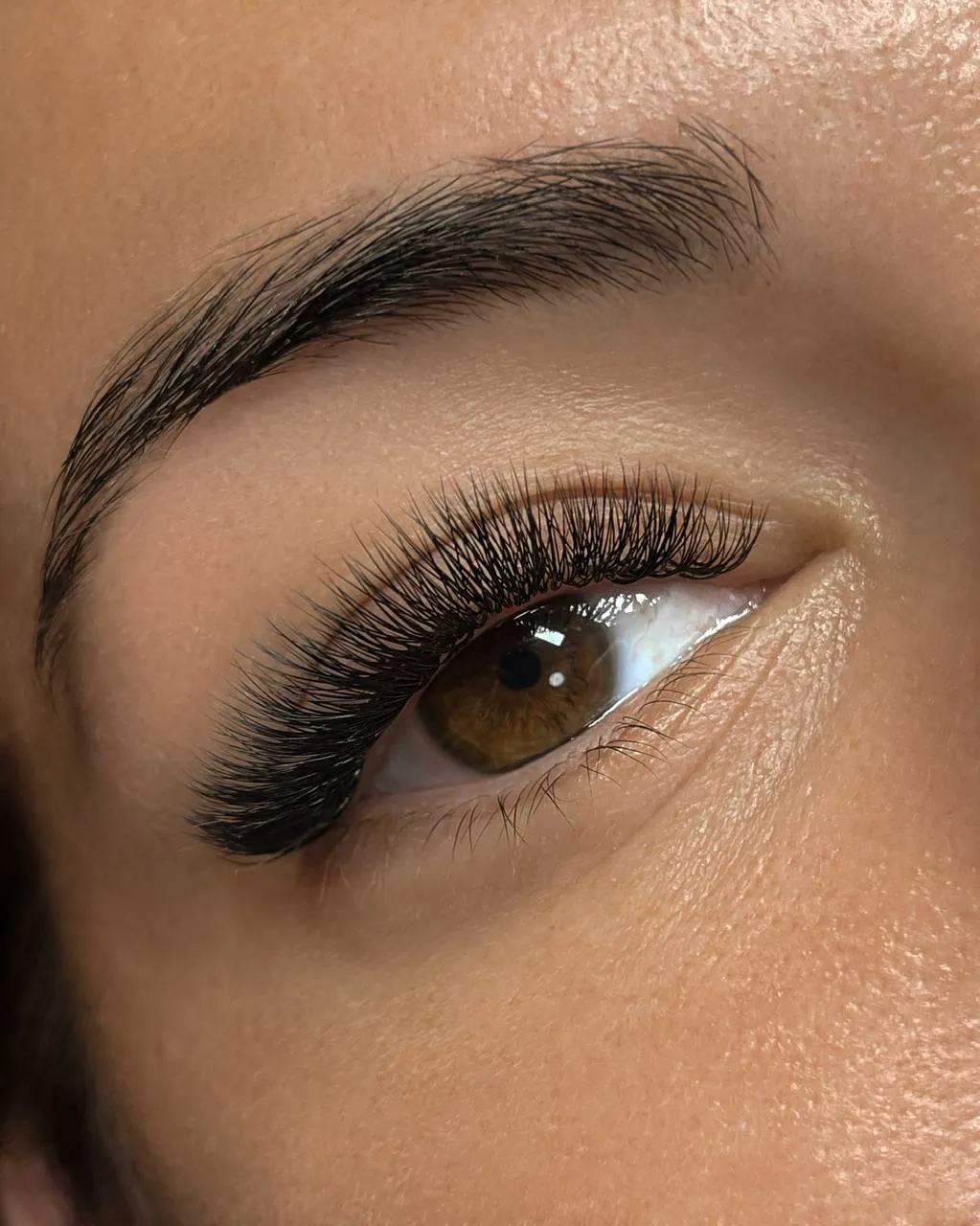
Cat eye at volume density
The limit nobody mentions
Length is capped by your own lash, not by the catalogue.
A natural lash can carry an extension roughly three to four millimetres longer than itself. Past that, the weight sits too far from the base, the lash twists, and it sheds early — the exact outcome people describe when they say extensions ruined their lashes.
This is the request we turn down most often, and it is almost always someone asking for a length they saw on a different lash line. If your own lashes are 8mm, a 15mm extension is not a style choice, it is a weight problem. What we can do instead is add density, which reads as fuller without adding leverage — and that is a tier decision, not a map one.
Keep reading
Then book.
Questions
Styles and eye shapes.
What lash extensions are best for hooded eyes?
A flatter curl — B or L rather than D — in a cat eye or kitten map, with the length kept moderate so the lashes clear the hood instead of curling up into it. The common mistake is a strong D curl with long lengths, which disappears under the fold: you pay for lashes nobody can see, including you. Hooded eyes are the shape mapped wrong most often, so if a previous set vanished on you, this is usually why.
What is the difference between cat eye and doll eye lash extensions?
Where the longest lashes sit. Cat eye puts them at the outer corner, which stretches the eye sideways and reads as lifted. Doll eye puts them over the centre of the iris, which opens the eye and makes it rounder. Cat eye suits round eyes; doll eye suits wide-set and upturned eyes. Kitten sits between the two and is the safe choice when you are unsure.
Does lash style depend on the density tier?
No. Style is the map — where length goes and at what curl — and density is how many extensions are fanned onto each natural lash. Any style can be built at any tier, from classic 1D to mega volume 6D+. The one practical exception is wispy: the alternating spikes read strongest on a 2D–3D or volume base, because the effect comes from varying fan sizes.
What is a wispy lash set?
Spikes of longer lashes set against a shorter base, so the lash line reads as texture rather than an even edge. It is a mapping style rather than a density, and it is built on a 2D–3D mix or volume base. Most of the sets saved on Instagram as "natural" or "wet look" are wispy maps.
How long can lash extensions be?
Roughly three to four millimetres longer than your own natural lash. Beyond that the weight sits too far from the base, the lash twists and it sheds early — which is the damage people attribute to extensions in general. If your natural lashes are short, the way to look fuller is more density at a fine diameter, not more length.
Can I bring a photo of the lashes I want?
Please do, and expect an honest reading of it. We can see the map in a photograph in a few seconds, but the eye in it is not yours — so we will tell you which parts of it will work on your lash line and which will not. That conversation is the point of mapping, and it is free with every set.
What lash style suits mature eyes or a relaxed lid?
Shorter lengths at a lifted curl, with the fullness coming from fine fans rather than from longer lashes, usually in a softly lifted kitten map. The frequent mistake is length: long extensions on a relaxed lid lean on the skin and pull the whole eye downward, which is the opposite of the lift people are asking for.
What is the difference between a C curl and a D curl?
How hard the extension curls upward. A C curl is a natural, rounded lift and the one that suits the widest range of eyes. A D curl is a stronger lift, which reads as more open and more dramatic and photographs harder. Flatter curls — B, and L with its sharp angled base — exist for lids that a C or D would disappear under, which in practice means hooded eyes and some monolids. Curl is chosen from your lid position, not from the photo you brought, and it is the single setting people most often get wrong.
What lash lengths do you use, and how do I know which is right?
Lengths are not one number — they vary in zones across the eye, which is what the map on the patch shows you. The rule that caps all of it is the natural lash: an extension can safely run about three to four millimetres longer than the lash it sits on, and past that the weight sits too far from the base and the lash twists and sheds early. So the answer is set by your own lash line rather than by a chart, and if your lashes are short the way to look fuller is more density at a fine diameter, not more length.
Every visit
FreeLash mapping.
1019 Avenue P, Suite 703, Gravesend, Brooklyn 11223. Sets from $120, and first visit is $20 off. Not sure which map suits you — text a daylight photo of your eyes, no makeup, and we will tell you honestly.