
Gravesend · Avenue P · Brooklyn 11223
Cluster lashes, DIY kits or lash extensions?
Clusters, strips, magnetics and professional sets, compared honestly
The short answer
What a cluster is, and why that matters.
A cluster is a small bundle of three to ten fibres joined at a knotted base. That base is wider than one natural lash, so a cluster necessarily rests on several of them — which is the definition of a stickie, built in at the factory. Worn for one night and taken off, that is survivable. Worn for two weeks as "DIY lash extensions", it is precisely the mechanism that damages natural lashes, because lashes shed on individual cycles and one lash trying to shed drags its neighbours out early. A professional extension is bonded to one isolated natural lash, which is the entire technical difference and most of what the ninety minutes buys.
Before anything else
We do not apply clusters, strips or magnetics.
Stated up front, as on every comparison page here. DEEPINLASH applies professional extensions one lash at a time, and does brow lamination. We do not fit cluster lashes, strip lashes or magnetic lashes, and we are not going to quote you a price for something we do not do.
What that means for this page: there is nothing to sell you in three of the four columns below. If you read it and conclude that strips for a wedding or magnetics twice a month fit your life better than a two-to-three-week refill rhythm, that is a correct conclusion and you should do that instead.
Side by side
Four options, honestly.
Extension prices are ours. The other three columns deliberately have no price — we do not sell them, so any figure would be invented.
| Strip lashes | Magnetic lashes | Cluster lashes | Pro extensions | |
|---|---|---|---|---|
| Attaches to | Lid skin, along the lash line | A magnetic liner on the lid | Several natural lashes at once | One isolated natural lash |
| Designed to be worn | One day, then removed | One day, then removed | One day — though sold as multi-day | Continuously, with refills |
| Applied by | You, in minutes | You, in minutes | You, or a salon | A lash artist, ~90 minutes |
| Risk to natural lashes | Low if removed properly; adhesive sits on skin | Lowest — no adhesive on the lash at all | High when worn for days, because of the shared base | Low when weighted, isolated and dissolved off |
| Looks natural up close | Visible band at the lash line | Visible band, plus liner | Visible knots between gaps | No band, no knot |
| Survives sleeping in | No | No | Badly, and that is the damage | Yes |
| Swim, shower, gym | No | No | Not reliably | Yes — same day with the LED bond |
| Daily effort | Apply every morning | Apply every morning | Apply, then worry | Clean them, 90 seconds |
| Price here | Not offered | Not offered | Not offered | $120–$180, refills from $100 |
The mechanism
Why a cluster worn for a week costs you lashes.
This is not a moral argument and it is not salon propaganda. It is a shedding problem, and it goes in four steps.
- Your lashes shed on staggered cycles. Each natural lash lives six to eight weeks and they are not synchronised, so you lose a few every day. Normal.
- A cluster's base spans several of them. The knot is wider than one lash, so it physically has to rest on two, three or more.
- One of those lashes reaches the end of its cycle. It tries to shed — and it is tied to neighbours that are not ready.
- It pulls them out with it. Repeat across a lash line for a week or two and you get the patchy, short, uneven result people describe as "extensions ruined my lashes". The extensions were not the problem; the shared base was.
Worn for an evening and removed the same night, none of that has time to happen. The harm comes from duration, not from the cluster existing.
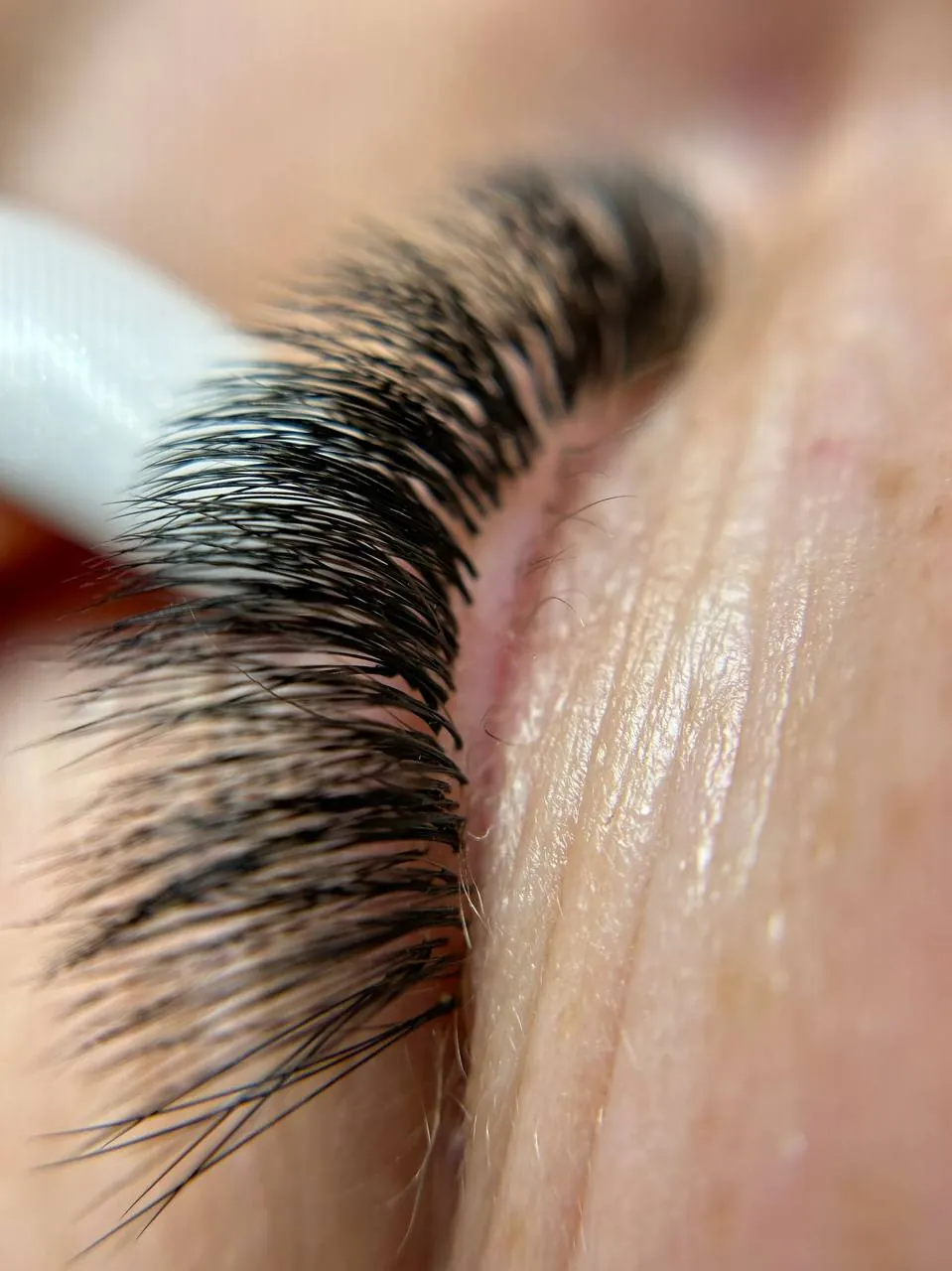
Handmade fans, one natural lash each
Why a volume fan is not the same thing. A fan also contains several fibres — four, five, sometimes eight. The difference is where they meet: a fan is made at the chair and placed on one isolated natural lash, so it sheds with that lash and nothing else. A cluster's knot sits across several. Same fibre count, opposite consequence. How volume fans are built.
DIY kits
Why "lash extensions at home" mostly is not that.
Kits sold as at-home lash extensions are almost always clusters with a bonding agent, marketed on a multi-day wear claim. The fibres are not the issue — the claim is. Three things make the home version behave differently from a studio set:
What we will not pretend: plenty of people wear DIY clusters for an evening with no consequences at all, and saying otherwise would be dishonest. The pattern we actually see in the chair is the two-week wear — someone who followed the box, slept in them, and arrives with bonded lashes. If that is you, it is a routine appointment and nobody is going to tell you off.
How to decide
When each one is genuinely the right answer.
Including the cases where it is not us.
The cost argument, honestly
Extensions are the expensive option. Obviously.
Any page that compares these and concludes the professional service is also the cheapest is lying to you. At a three-week rhythm, extensions here run roughly $2,020 a year on classic and about $2,830 on volume — around twenty appointments. A box of strips or a magnetic set is a fraction of one visit.
What the money buys is not fibres. It is isolation, weight matched to your lash, a shape mapped to your eye, and a removal that dissolves rather than pulls. Whether that is worth two thousand dollars a year depends entirely on how often you want to look like that — every day, or eight times a year. We are not going to tell you the answer, because for a lot of people it is honestly the magnetic set.
If extensions are the answer
Where to go next.
Questions
Clusters, kits and extensions.
What is the difference between cluster lashes and lash extensions?
A cluster is a bundle of three to ten fibres joined at a knotted base that is wider than one natural lash, so it rests on several at once. A professional extension — single or a handmade fan — is bonded to one isolated natural lash. That is the whole technical difference, and it is why clusters cause problems when worn for days while extensions do not.
Do cluster lashes damage your natural lashes?
Worn for one evening and removed, usually not. Worn for days, yes, and by a specific mechanism: the shared base ties several natural lashes together, and lashes shed on staggered cycles, so a lash reaching the end of its cycle pulls its neighbours out early. Repeat that across a lash line for a week or two and the result is the patchy, uneven line people blame on extensions in general.
Are DIY lash extension kits the same as salon extensions?
Almost never. Kits sold as at-home extensions are generally clusters with a bonding agent, marketed on a multi-day wear claim. Three things differ: you cannot isolate your own natural lashes, which is the step that prevents lashes being bonded together; kit adhesives are formulated to be forgiving and wearer-removable rather than to hold one fibre to one hair for weeks; and nothing in a kit declines a length your lash cannot carry.
If a volume fan has five fibres, how is it different from a cluster?
Where the fibres meet. A volume fan is made by hand at the appointment and placed on one isolated natural lash, so it sheds with that lash and nothing else. A cluster's knot sits across several natural lashes. Same fibre count, opposite consequence — which is why volume sets are not "clusters you pay more for".
Do you apply cluster, strip or magnetic lashes?
No. DEEPINLASH applies professional extensions one lash at a time and does brow lamination. We do not fit clusters, strips or magnetics, and there is no price for them in the comparison above because we do not sell them. We do remove clusters that have been worn too long — $25, dissolved rather than pulled, and free when you book a set the same visit.
Which is cheaper, lash extensions or strip lashes?
Strips, by a wide margin, and any comparison that claims otherwise is not honest. Extensions at a three-week rhythm work out around $2,020 a year on classic and about $2,830 on volume, across roughly twenty appointments. A box of strips or a magnetic set costs a fraction of a single visit. The question is how often you want the look — every day, or a handful of times a year.
Are magnetic lashes safer than lash extensions?
In one narrow respect, yes: no adhesive touches the natural lash at all, so there is nothing to bond lashes together and nothing to dissolve off. They are also removed the same day rather than worn continuously. What they do not do is survive sleeping, swimming or the gym, and they leave a visible band and liner. Safer is accurate; equivalent is not.
I slept in cluster lashes for two weeks. What should I do?
Book a removal — $25, about twenty minutes, dissolved off rather than pulled, and free if you book a new set the same visit. Do not pull them out yourself, because adhesive is stronger than a lash follicle. If the lash line is visibly stressed we will recommend a break of four to six weeks before a new set and explain why, rather than applying one over damaged lashes. It is a routine appointment and nobody is going to tell you off.
New clients
$100Your first classic set.
1019 Avenue P, Suite 703, Gravesend, Brooklyn 11223. Wearing clusters now? Text a daylight photo and we will tell you whether it needs removal, whether your lash line needs a break first, or whether you are fine.